The Vision Is the Invariant. The Strategic Narrative Should Move.
Building a company right now, when everything seems to move at the speed of light, has had me thinking about the difference between a company’s long-term vision and its strategic narrative.
They aren’t the same thing.
Most companies have some core idea that should change very little: the thing they want to make true for customers over the long run. I’ve started thinking of that as the invariant.
The strategic narrative is the story about why that idea matters now. What changed in the world? What no longer works? Why is this company relevant to the shift? That story can, and probably should, change much more often.
I first came across this way of thinking at my first Pavilion GTM Conference in Nashville in 2023. Andy Raskin gave a really good talk called “Goodbye Product, Hello Movement,” using Salesforce’s original and famous “End of Software” campaign as one of his examples.
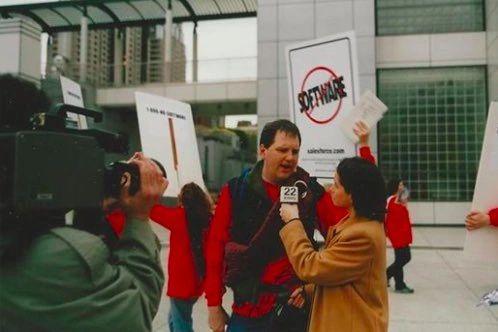
I then found a simple way to see narrative development in practice: look at a public company’s 10-K filings.
Near the beginning of every 10-K, the company has to describe its business. Put those descriptions next to each other over a decade or two and you can watch the narrative move.
So I did this for Salesforce: every 10-K from fiscal 2005 through 2026, 22 filings in total. You can find the source material in Salesforce’s SEC filings archive.
Here is the short version:
- 2005-2009: “Application services” and “software on demand.” The contrast was with expensive, complex, on-premise enterprise software.
- 2010-2011: “Enterprise cloud computing.” Cloud had become the accepted category, and Salesforce was expanding from a CRM application into a platform.
- 2012: The “social enterprise.” Social, mobile, and open technologies were changing how companies engaged customers and employees. The phrase disappeared from the opening one year later.
- 2013-2017: Enterprise cloud solutions, then enterprise software focused on CRM. The mission expanded toward helping customers connect in new ways through cloud, mobile, social, IoT, and AI.
- 2018-2020: Salesforce described itself as the global CRM leader. Customer connection became the main outcome. Blockchain and voice both made brief appearances in the supporting technology list. Blockchain was a funny one.
- 2021-2023: Customer 360, a single source of truth, and the all-digital, work-from-anywhere world.
- 2024-2026: Trusted AI, humans working with AI agents, and now the “agentic enterprise.”
Through all of this, the core idea barely moved: Salesforce helps businesses manage and improve their relationships with customers.
Changing the narrative doesn’t necessarily mean a company keeps changing its mind about what it is.
The core can stay fixed while the story moves with the market. In fact, it probably has to.