Love, Not Adoption, Is the Real Product Moat
We recently ran the Ellis Test at Glyphic: how would users feel if they could no longer use the product?
Seventy-five percent said they would be very disappointed. A smaller group said they would be somewhat disappointed.
That distinction sounds semantic. It isn’t. It is a signal worth mining.
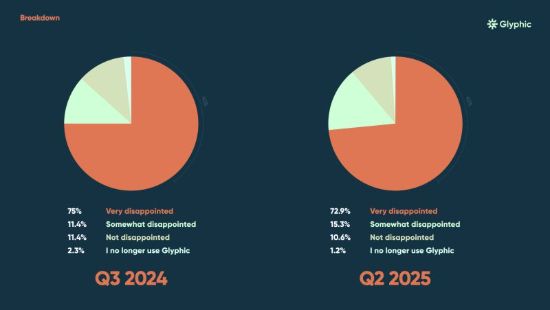
The somewhat disappointed users liked concrete features: call recordings and summaries, sales-framework highlights, AI search, CRM sync, and coaching tools. Their answers were positive, but narrow. The product helped them with a collection of tasks.
The very disappointed users spoke differently:
I’d be screwed without Glyphic updating my Salesforce.
I don’t have to rely on my brain anymore. I can just ask Glyphic.
It makes my job easier across the board.
The difference was not the number of features they used. It was the role the product played in their work.
The first group described a useful tool. The second described something closer to a trusted teammate. It had become part of how they operated, not merely something they opened.
This is why adoption can be a misleading product metric. A feature can be used because it is bundled, required, or marginally more convenient than the alternative. Usage tells you that the product is present. It does not tell you whether the product matters.
Love shows up differently. Users recommend the product without being asked. They reorganize workflows around it. They describe losing it as a disruption, not an inconvenience. They depend on the product across multiple jobs instead of visiting it for one isolated task.
That dependency is particularly important for AI products. It is easy to generate a compelling output once. It is much harder to become reliable enough that someone delegates part of their job to you every day.
The practical lesson is not simply to run a survey and celebrate a percentage. Segment the answers. Read the language. Compare what users say they value with how deeply the product has entered their workflow.
Adoption is only half the battle. Love is the real moat.